Most leadership training programs are designed to build capability, but not capacity. They equip leaders with tools, frameworks and strategies to perform better, yet ignore the biological and cognitive systems that sustain that performance over time.
The result? A growing leadership crisis hiding in plain sight.
Gallup’s 2023 “State of the Global Workplace” report found that 44% of employees experienced stress “a lot of the previous day,” and managers report the highest daily stress levels in the workplace.
What’s striking is that these are not signs of laziness; they’re signs of systemic overload. Performance doesn’t collapse in a single moment. Rather, it erodes gradually, through cognitive fatigue, emotional depletion and decision fragmentation. That erosion often starts years before visible burnout appears.
Thus, leadership doesn’t typically fail because of a lack of ambition but because of a lack of bandwidth. That’s precisely what “performance span” seeks to measure: the capacity to perform at a high level without degradation over time.
What Is “Performance Span”? The Hidden KPI of Sustainable Leadership
Performance span is a new leadership metric designed to measure how long an individual can sustain clarity, creativity and decision quality before fatigue degrades performance. Think of it as the VO₂ max of leadership. A measurable indicator of endurance, not intensity.
Traditional performance metrics like output, hours or deliverables measure activity. Performance span measures sustainability. It captures three interdependent dimensions of leadership performance, including:
- Capacity: How much energy and focus a leader can sustain under cognitive load.
- Longevity: How long that clarity and composure can be maintained before fatigue sets in.
- System Health: How quickly the leader recovers and recalibrates between periods of high demand.
This shift in measurement reframes performance from a short-term sprint to a long-term, systemic capability — one that aligns human endurance with organizational resilience.
As one chief human resources officer put it in a recent Deloitte roundtable: “We’ve spent decades teaching leaders to go faster. Now we need to teach them how to last.”
The Cost of Ignoring It: The Economics of Cognitive Fatigue
The financial impact of ignoring leadership fatigue is both measurable and significant.
The American Psychological Association summarizes research showing that repeated decision-making reduces self-control and decision quality, particularly later in the workday. Gallup estimates that burnout costs the global economy $322 billion annually in lost productivity. Deloitte’s UK mental health research estimates the employer costs of poor mental health and from absenteeism, presenteeism and turnover at £51-56 billion per year, with presenteeism the largest contributor.
At an organizational level, the hidden costs compound:
- Turnover: SHRM estimates replacing a senior leader costs 1.5–2 times their annual salary.
- Error rates: Fatigued leaders make more reactive decisions, increasing rework and risk exposure.
- Engagement drag: Manager burnout is associated with lower team engagement and productivity
These figures illustrate what I call the “resilience tax,” or the hidden cost of running beyond recovery. It’s a tax most organizations pay every day without noticing, quietly draining both human and financial capital.
Why Current Leadership Training and Development Falls Short
For years, leadership training and development has focused on skills acquisition — communication, delegation, emotional intelligence and strategic thinking. While these are essential, they only tell half the story. In most programs, leadership capability is developed in isolation from leadership capacity. We measure what leaders know and do, but not how long they can sustain clarity and composure under real-world pressure. The assumption that leaders can continually perform at peak cognitive and emotional levels is a dangerous one and it’s breaking even the most capable professionals. Put simply: Skills without stamina are a depreciating asset.
A more intelligent model recognizes that leadership performance is an energy system, not a personality trait. Without supporting the physiological and cognitive architecture behind it, no amount of training will sustain behavioural change.
The Performance Span Model: Turning Physiology Into Strategy
Performance span provides a structured model for integrating human performance science into leadership design. It’s built on a simple but powerful premise: the human nervous system is the operating system of leadership performance.
To operationalize it, we use the S.E.N.S.E. model, which defines the five measurable domains that sustain clarity and decision quality:
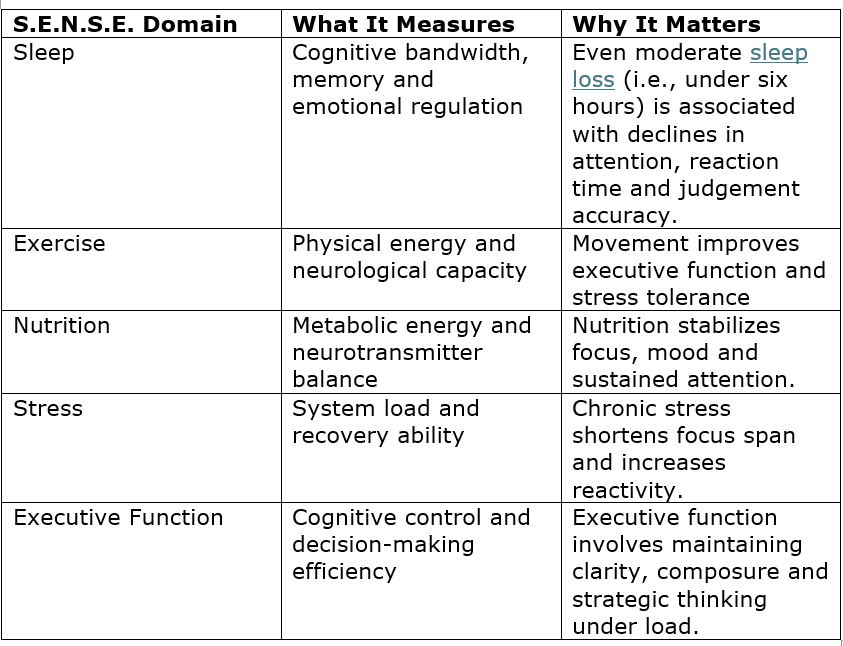
Together, these domains form a resilience rhythm; the deliberate alternation between load and recovery that allows leaders to perform sustainably. It translates biology into performance strategy and it’s measurable, coachable and scalable across entire organizations.
How L&D Can Integrate Performance Span Thinking
For learning and development (L&D) leaders, the challenge — and opportunity — lies in embedding performance span into the design, delivery and evaluation of leadership training programs.
Here are three evidence-based ways to start:
1. Run Capacity Audits Before Capability Programs
Before designing another leadership curriculum, assess the system leaders are performing within. Use workload analysis, energy diagnostics and engagement surveys to map resilience gaps. This identifies why leaders underperform before prescribing what they need to learn.
Example metric: Track “energy per decision” — how long leaders sustain decision quality under cognitive load.
2. Integrate Recovery Into Learning Design
Borrow a concept from athletic training: Build learning cycles with deliberate load and recovery phases.
- Load: Engage leaders in immersive challenges, simulations and high-stakes exercises.
- Recovery: Follow with structured reflection, coaching sessions and dedicated time to process insights and recharge.
This approach ensures leaders absorb learnings effectively and maintain performance without burnout
3. Track Energy-Based KPIs Alongside Learning KPIs
Move beyond participation and completion rates. Add metrics that measure cognitive, emotional and physical capacity.
Suggested indicators:
- Cognitive bandwidth: Measure decision-making speed and accuracy under pressure.
- Resilience index: Use surveys to gauge energy, focus and stress recovery.
- Performance span index: Combine physiological and behavioral data to assess how long leaders sustain high performance.
Tracking these key performance indicators (KPIs) alongside learning outcomes helps ensure leadership development translates into real-world performance. When L&D teams begin tracking capacity, not just competency, leadership transformation compounds because sustainable performance becomes a designed outcome rather than an accidental one.
The Strategic Payoff: Resilience as Competitive Advantage
Embedding performance span metrics into leadership development drives three strategic business benefits:
1. Improved Productivity
When leaders manage energy as deliberately as time, performance variability decreases. Teams experience fewer cognitive crashes, leading to more consistent output across cycles.
2. Leadership Retention and Engagement
Gallup has reported that organizations improving manager well-being practices can see 25-32% lower voluntary turnover.
3. Enhanced Decision Quality
McKinsey links faster decision-making processes and faster execution to higher returns, and finds executives spend a large share of time on decisions that is often poorly used. More research from McKinsey outlines practices that lead to faster, better decisions and improved performance at scale and that high-performing teams make decisions three times faster and two times more accurately when operating in clear cognitive states. Incorporating performance span principles extends those clear states.
Ultimately, performance span turns leadership performance from reactive to renewable, building endurance that directly translates into business agility.
The Future of Leadership Training and Development
For decades, leadership performance frameworks have been built on the assumption that human capacity is constant. Neuroscience and physiology now tell us the opposite. Capacity is dynamic, measurable and trainable.
Wellness initiatives were a start, but they were reactive. Performance span is proactive, embedding resilience into the system itself. The next generation of leadership training programs will combine capability development with capacity design. They’ll measure leadership longevity the same way we measure profitability: with data, rhythm and precision.
When that happens, L&D will no longer just develop leaders; it will engineer endurance.
Final Thought
The future of leadership won’t be defined by who works the hardest. It will be defined by who can stay clear, composed and strategic the longest. Performance span is the KPI that makes that measurable. And for L&D leaders, it’s the key to unlocking a new era of sustainable, high-performing leadership, one where energy, not just effort, drives results.