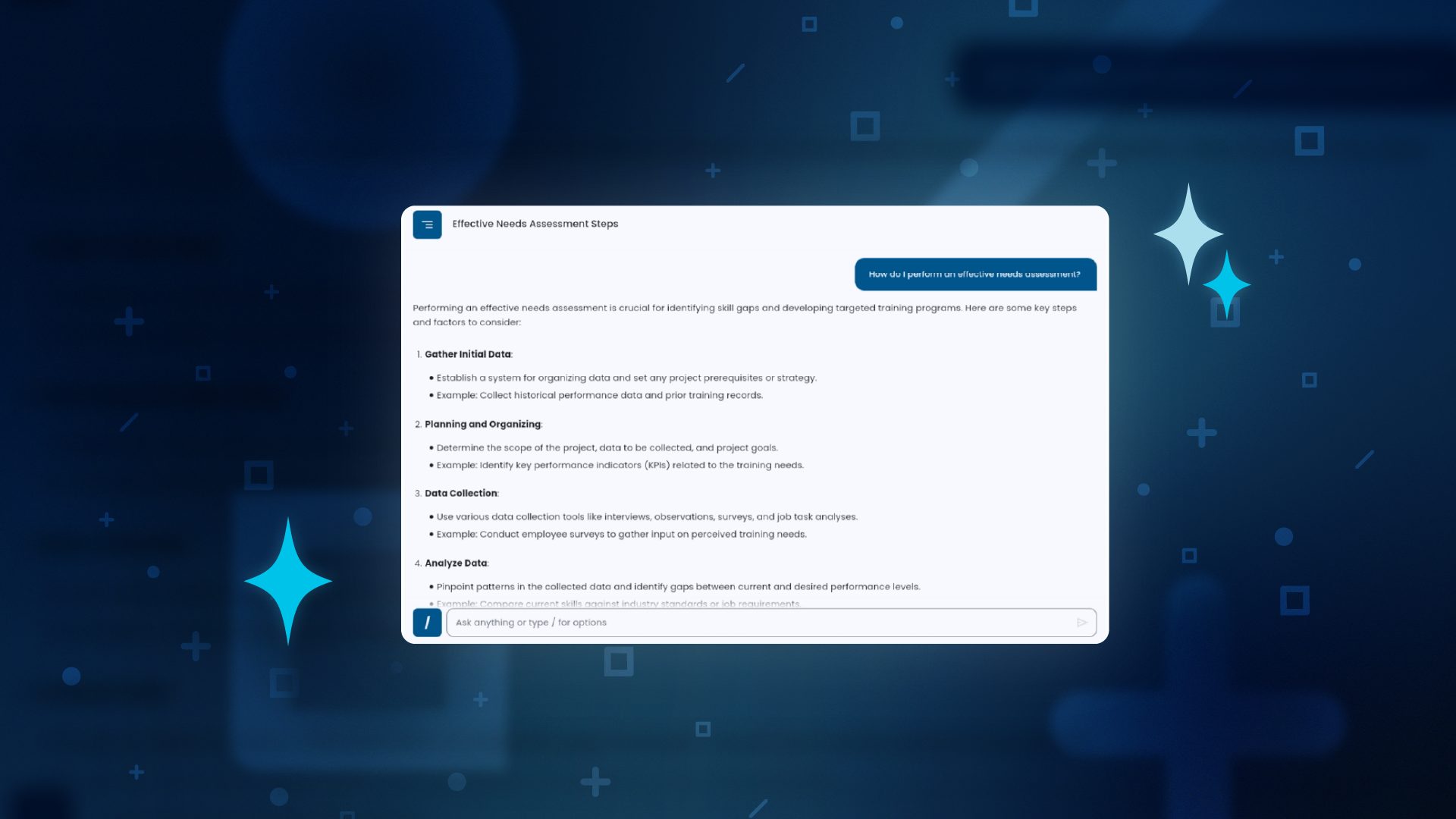
Artificial intelligence (AI) is changing how work gets done across industries and learning and development (L&D) is no exception. From automating repetitive tasks to generating fresh ideas, AI tools like ChatGPT and Copilot offer broad support to professionals in many fields.
For corporate learning teams, however, general-purpose tools often fall short. The work of L&D is nuanced, strategic and deeply tied to business outcomes. It demands more than quick answers. It requires context, accuracy and expertise.
That’s where a purpose-built AI agent for L&D makes all the difference.
An AI Agent That Speaks the Language of L&D
L&D has its own language — full of models, metrics, acronyms and frameworks that don’t always translate in generic AI tools. Many large language models (LLMs) offer broad definitions but struggle to grasp the nuance between learning strategy and learning delivery, or between coaching and mentoring.
An AI agent trained specifically in L&D understands the terms, roles and instructional approaches that learning leaders use every day. For example, Tia, Training Industry’s AI Agent, is fluent in this space. Tia recognizes frameworks like ADDIE, Agile, and the Training Manager Competency Model™ and can apply them directly to real challenges. When asked about building leadership programs or upskilling strategies, Tia delivers structured, strategic advice grounded in proven approaches, not just stopping at surface-level definitions.
Grounded in Trusted Knowledge, Not Open-Source Content
One of the risks of using generic AI tools is their reliance on internet-sourced content — much of which may be outdated, inconsistent or simply wrong. This increases the risk of hallucinations (when the AI confidently presents incorrect information as fact).
By contrast, an L&D-specific AI agent like Tia pulls only from vetted, professional sources and refrains from answering when a reliable response isn’t available. Tia’s responses are built on more than 20 years of curated research, frameworks and course materials developed by Training Industry. Rather than fabricating an answer, Tia will acknowledge gaps in the training set and point learning leaders toward more targeted sources.

Transparent Sourcing Across L&D Media Formats
Effective learning professionals rely on more than just articles. They use research reports, infographics, podcasts, webinars and job aids to guide their decisions.
A strong AI agent shouldn’t just provide answers — it should also reference the sources behind those answers. This transparency builds trust and helps learning leaders explore further, cite resources or share them with stakeholders.
Tia does exactly that, offering full citations when possible and linking directly to original content inside the Training Industry library, including podcast episodes, research studies or downloadable e-books.
Support for Strategic Alignment and Program Design
Designing training programs that drive business outcomes is at the core of L&D’s strategic value. While generic AI tools might help write course descriptions or suggest topics, they often miss the bigger picture of how learning connects to performance and organizational goals.
Tia, on the other hand, is built with that connection in mind. Tia can support key responsibilities like needs analysis, stakeholder communication and program development — all aligned with the core competencies of a modern training manager.
Designed for the L&D Workflow
General AI tools tend to exist as standalone applications. But L&D professionals need AI tools that fit seamlessly into their workflow.
Tia is embedded directly within the Training Industry membership platform, making it easy for professionals to access content, connect with frameworks and ask follow-up questions in one place. This integration ensures that AI isn’t operating in a vacuum, but actively complements the tools and knowledge L&D leaders rely on every day.
Final Thoughts: L&D Needs an AI That Gets It
AI isn’t going away and neither are the challenges of aligning learning with performance, engaging learners and proving impact. That’s why it’s critical for L&D professionals to have access to AI agents that are trained for L&D, by L&D experts.
A learning-focused AI agent should offer:
- Language fluency in L&D strategy and design
- Trusted, hallucination-free insights
- Clear citations and media-rich source material
- Support for training manager competencies and strategic planning
- Integration into the tools and workflows L&D teams already use
Tia is one example of what this looks like in practice. The table below highlights the key differences between generic AI tools and an L&D-trained AI agent.
| Category | Challenges With Generic AI | Advantages of L&D-Specific AI Agent |
|
L&D Language Fluency | Generic definitions; struggles with L&D-specific models and nuances.
| Understands L&D models and frameworks.
|
|
Knowledge Sources | Relies on open web content; risk of outdated or inaccurate info.
| Uses vetted L&D research and curated frameworks. |
|
Source Transparency | No clear or consistent source citations. | Provides full citations with links to varied media, such as research reports, webinars and job aids.
|
|
Strategic Alignment | Surface-level help; weak on connecting to business goals. | Supports needs analysis, stakeholder communication and program design tied to organizational goals.
|
|
Workflow Integration | Standalone tool; not embedded in L&D workflows. | Integrated into L&D platforms with built-in access to resources and follow-up tools.
|