


Published in Fall 2025
Within many organizations, the training department is viewed as the department that forces everyone to complete mandatory training or introduces new applications or processes to team members who think the older versions work “just fine.” If that perception sounds familiar, this article will highlight three actionable strategies to help you reshape how your department is seen. The trick is to think like a marketer.
Promoting your training department’s role in key workforce areas will both showcase its value and reinforce its position as a go-to resource within your organization. Here’s how to get there:
Build a Logo for Instant Connection
Think of Nike, McDonalds and Apple. Just reading or hearing the names of these companies conjures their iconic logos. A logo is the visual representation of a brand, making it easily recognizable to consumers and helping them quickly identify a company or product.
A great logo can make you stand out, communicate values and personality, build trust and loyalty and, when used consistently, create brand awareness and reinforce brand identity.
Developing a unique logo is one effective way that you can help your organization’s members recognize who the training department is and what it stands for. To create a logo for your training department, consider these key elements:
- Imagery: Use an icon or symbol that reflects learning, growth or your department’s mission. Keep it simple and memorable.
- Typography: Fonts can be a powerful tool in logo design and branding. Match the font to the message you want to convey. For example, bold, heavy fonts imply strength and power, while flowy fonts convey elegance and creativity.
- Color palette: Align with your organization’s brand color if possible. And keep in mind that colors ignite emotions or thoughts. Blue conveys trust; red grabs attention; green implies growth.
- Tone of voice: The imagery, typography and color palette you select will all give your logo the elements to make it instantly recognizable, but the tone of voice of your brand is represented in how you communicate in messaging and interactions with your internal stakeholders. To define your tone of voice, consider your organization’s culture and how it aligns with your department’s mission. If your culture is buttoned up and serious, then your logo and communications should match.
Once you have determined your training department’s brand identity and your logo is created, you can begin an internal campaign to create some buzz.
Here are a few ways to start:
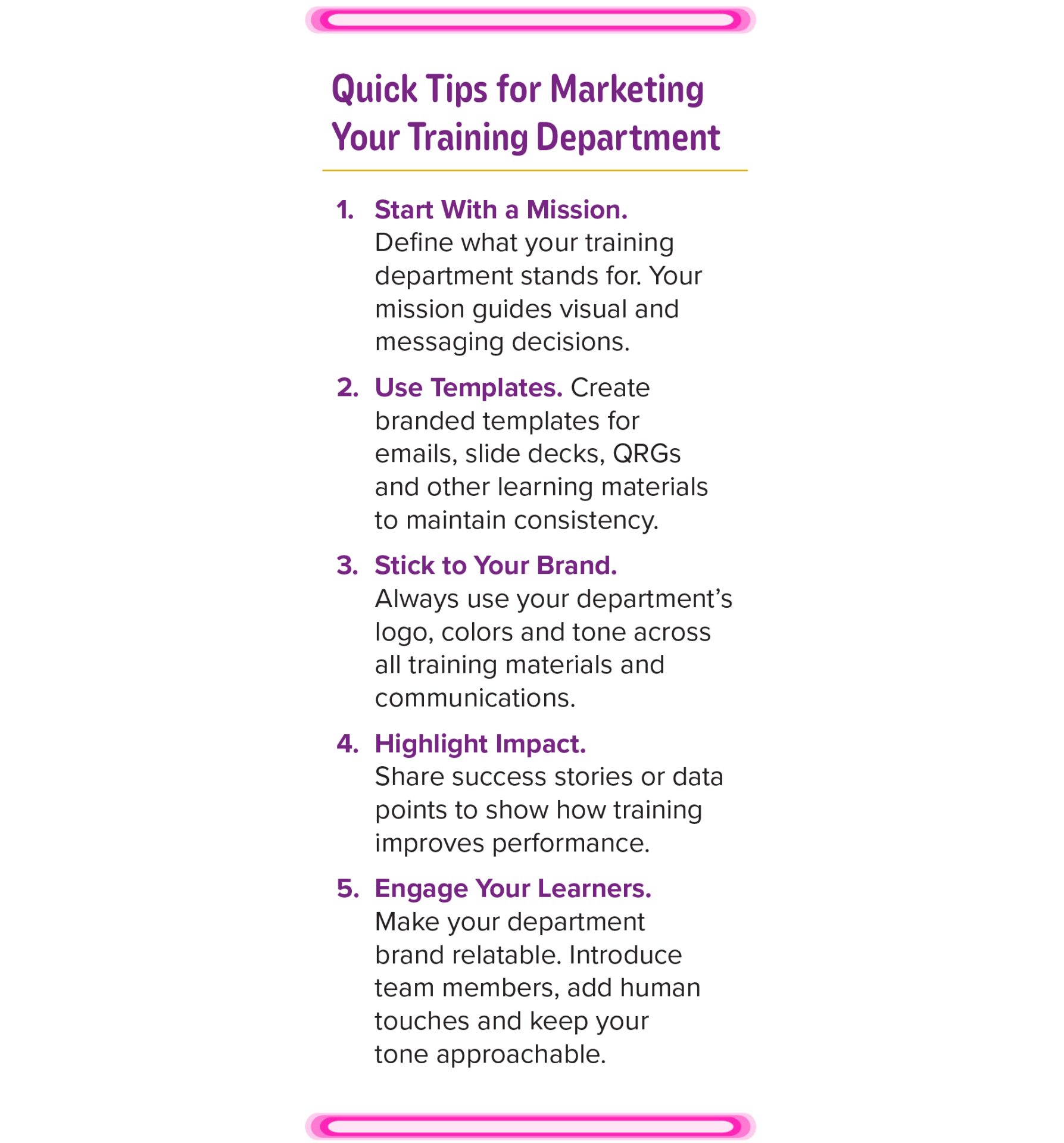
- The slow drip: Gradually incorporate your logo into all training materials, from slide decks to quick reference guides (QRGs). To maintain consistency in your branding, create templates with the logo placed prominently. Consider asking your IT department if your logo can be placed on all training department email signature lines.
- The air of mystery: Print out the logo on a blank white background with a tagline like “It starts here…“ or “Where growth begins…“ Include a call to action, such as a QR code to scan or a URL that directs users to your training department’s intranet page, a PDF that highlights all of the training department’s functionalities or a bio for your new logo describing how the different elements represent your brand identity.
- The scavenger hunt: Hide your logo on your department’s intranet site or within specific training materials. Kick off the hunt with an email displaying your department’s logo and offer a prize to the first person that finds it.
After the internal campaign is kicked off, use the logo consistently. Place your logo prominently on all training materials and communications, both digital and print. Over time, your logo will create an instant connection to your training department.
Host Signature Events
Many organizations invite their clients or customers to regularly occurring or “signature” events. Signature events can help establish and reinforce your department’s identity, allow opportunities for strategic communication and position your department members as learning and development (L&D) leaders within your organization.
To create a signature event that will reinforce your brand identity, look at your organization’s industry and culture. The signature event should reflect both. For example, when I was the technical trainer at a law firm, our signature event was a monthly, virtual training session that was scheduled for no more than 15 minutes. These sessions took place on the first Wednesday of each month at 10 a.m. The message around these monthly sessions was that if you attended, you would learn a new skill that would allow you to work more efficiently, giving more time back in the day to dedicate to legal work.
All of these decisions were made with purpose. The sessions were short because in a law firm time is measured in tenths — and every tenth counts. They were hosted virtually so that attendees could join from anywhere or view a recording on demand. And they were scheduled on Wednesday mornings to avoid conflicts with internal meetings and the business development efforts that often fill the lunch hour.
By hosting the event virtually, we emphasized the firm’s culture of inclusiveness. Keeping the sessions short and avoiding crucial hours out of the day, like the lunch hour, showed that we understood the scheduling needs of learners in our organization.
All of these details led to a successful internal signature event, with increased engagement and attendance quarter to quarter. The growing attendance numbers allowed our training department to strategically offer sessions related to application updates and rollouts, as well as issues that were common across the firm based on help desk call data.
Other signature event ideas include:
- Learning showcases: Invite other departments or team members to highlight how they are applying what they’ve learned from training.
- Lunch and learns: Provide demos or Q&As on software or tools used in your organization.
- Training department office hours: Allow team members to drop in and out to ask questions or get application or process insights from the training department.
Organizing and hosting a signature event is a lot of work — don’t let it go to waste after the event ends. Repurpose signature event materials by creating recordings, QRGs, writeups and other resources to keep the learning momentum.
Amplify Your Brand With MarComm
Often referred to as marcomm, marketing communications are all messages and media used to promote your brand and services to a target audience. By sending consistent, branded (remember that great logo you created?) communications, you can inform your organization of what the training department can offer, remind them of your value and presence and reinforce your brand identity and mission.
Marcomm can take many forms, depending on your audience and objectives. Consider you’re launching a new training program. You could:
- Send an email teaser to build curiosity.
- Create a poster or graphic announcing the launch.
- Record a short video highlighting the benefits of the new program.
- Send follow-up emails leading up to the new training program to encourage signups.
- Send follow-up emails following the new training program with links to any recordings and support materials.
In addition to using marcomm to promote training programs and other initiatives, you can consider creating regular content like monthly or quarterly newsletters. Newsletters provide a platform to announce upcoming training sessions, remind users of mandatory training obligations and provide links to recordings of previous trainings, learning management system (LMS) modules and other learning-centric sites.
Including a quick tip in newsletters is a powerful way to build a strong connection between learners and the training department. By proactively offering solutions to common challenges or sharing time-saving techniques, you demonstrate awareness of user needs and add immediate value. These unpromoted insights position the training team as a trusted, go-to resource across the organization.
Use marcomm to add a human element to your department. Introduce your trainers with their photo and contact information and include personal details they are willing to share, like what they did for their first job or how many pets they have and their names. Or highlight a “trainee of the month” or subject-matter expert in your organization. Connecting your training department to the real people behind the scenes, both the trainers and the learners, makes you relatable. Also, it’s much easier to ignore mandatory training emails from the anonymous training department than from Janet, your instructional trainer with three rescue dogs named Kirk, Pat and Rick.
Start Small, Build Steadily
Creating a strong brand for your training department won’t happen overnight, but taking small, incremental steps will allow you to build your brand and market the training department as the learning and development powerhouse of your organization. By adopting a marketer’s mindset, you can elevate the perception of your training department from a support function to a valued, strategic brand within your organization.