

Published in Fall 2025
For too long, learning and development (L&D) departments served as “order takers” — waiting for the business to request training for an initiative or to solve a problem. The tide has shifted in how L&D is perceived by the business, but many departments are still in the difficult transformation phase from order taker to strategic partner.
Whether you lead a training group, L&D or an organizational development (OD) department, it is important to step into the strategic partner space and take the necessary steps to show the value learning brings. An important first step in gaining a seat at the table is to take on a consultant role and engage in strategic needs analysis.
What Is Strategic Needs Analysis and Why Do It?
A strategic needs analysis can take many forms, depending on the scope of the effort. And it is an effort; it is a project of its own. It’s an overarching view into the organization to understand the business goals and how learning can drive those goals.
Starting with a strategic needs analysis, and doing it effectively and thoroughly, can make a significant difference in ensuring that learning and training efforts in your organization are valued and lead to tangible business results. When this happens, the learners, department and organizational leaders and the L&D function all win. Learners often receive targeted and applicable learning, department and organizational leaders see learning as an important business driver, and the L&D function gains that important seat at the table.
When to Conduct a Strategic Needs Analysis
There are many situations where the approach can be especially important. Starting up an L&D function in a growing organization is one instance. This is a great way to kick off a center of excellence and show that it isn’t fluff but tied directly to business strategy.
Another instance is when it is time to renew and refresh. If offerings for learning have become stale, it may be time to take a new approach. When doing so, focus first on the business goals and let those drive the updates to learning. Finally, when the organization announces new or updated strategic goals, that is an ideal time to consider how learning can serve those goals.
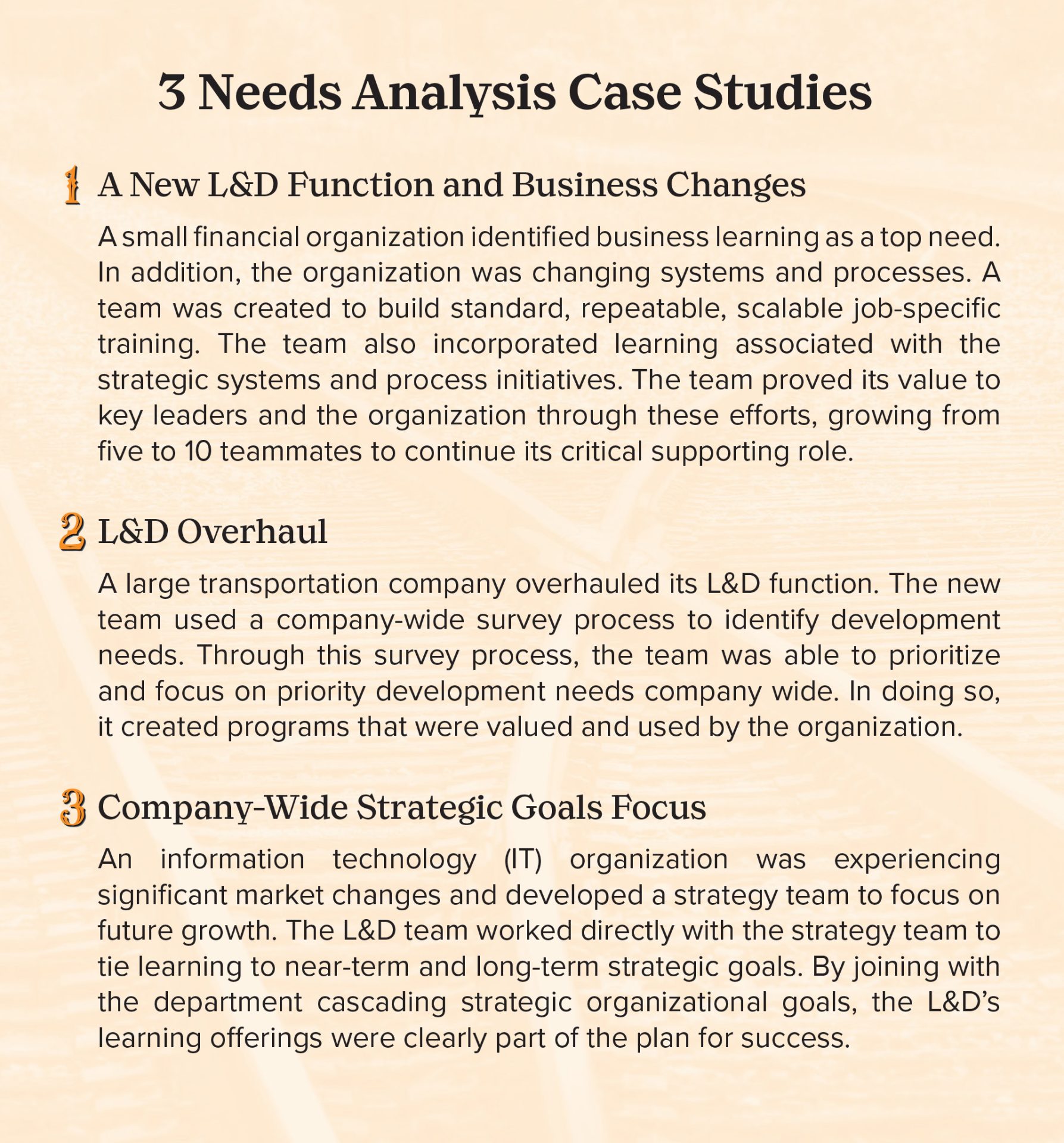
What Does Strategic Needs Analysis Look Like?
There are many ways to approach a strategic needs analysis, but there is one golden rule that must always be followed. It is well articulated in “Running Training Like a Business: Delivering Unmistakable Value,” in which the authors David Van Adelsberg and Edward A. Trolley write, “Remember that training is but a means to business ends.”
That may seem brutal. What about learning for learning’s sake? To enhance employee engagement? As a benefit to employees? It’s not to say that employee engagement and individual growth isn’t important, but L&D organizations need to be focused on more — they need to be looking at what drives business results.
Step 1: Understand the Strategic Business Goals
The first step is to understand those “business ends.” What are the strategic initiatives and goals of the organization and how will success be measured? How could learning assist in attaining those results?
If there is a strategy department in your organization, talk to them and ask about strategic business goals. Who owns them? If you have a change management department, do the same drill with them. Often learning accompanies change. Think of the ADKAR model — awareness, desire, knowledge, ability and reinforcement; learning is embedded.
If department-level strategic goals are published, review them and talk to those who have ultimate responsibility for those goals. Learn about the action plans the department will take to reach those goals and explore how learning can be part of that effort.
Step 2: Identify Necessary Knowledge, Skills, Abilities or Behaviors
Clarify the competencies or knowledge, skills, abilities and behaviors needed from employees to contribute to those strategic goals. The needs may be different in every department and you may need to interview multiple levels of management to really key in on the needs.
Step 3: Assess the Workforce
Assess employees’ knowledge, skills and abilities and identify gaps. This could include looking at the following:
- Overall tenure of the departments: Depending on how experienced teammates are, there may be a need to train newer employees or retrain experienced employees who aren’t adapting to new expectations.
- Manager surveys or focus groups: What do the managers say is needed? Be sure to contextualize your request in terms of the business goals.
- Employee surveys or focus groups: What do employees say they need to contribute to the business goals more effectively?
- Performance reviews: If possible, review performance feedback or development plans, especially if this can be done systematically through data analysis.
Step 4: Prioritize, Plan and Progress Learning Design and Development
The next steps are prioritizing the needs and planning the approach needed to meet those needs. This could include the design and development of courses, programs or learning experiences. It could also mean looking at vendor-provided solutions.
At this point, one or more projects will emerge from your strategic needs assessment and you should be prepared to follow best practices for any learning design project. These include:
Secure stakeholders and subject matter experts (SMEs): Identify the right people to work with and ask for commitment to the effort. In efforts tied directly to business needs and results, it is especially important that the right people are involved. That means they can be spokespeople — supporting, promoting and emphasizing the contribution the learning will make to success. Ideally, they should also be accountable for the success measures.
Identify success measures: Remember, the learning is intended to support specific business results. How will learning contribute to securing those results? How will that be measured? When should it be measured? Also, employees’ participation is important, so have a plan to track learning enrollment and completion and follow up with stakeholders immediately if you see issues with participation.
Design and develop: As the solution is designed and developed, ensure it is as connected as possible to the business. Use specific examples and scenarios that are familiar to the audience. Design experiences that tie directly to the application of the learning. If possible, design challenges or tests that check for an employee’s ability to transfer the learning to what must be done on the job.
Plan and deploy: Plan for deployment or completion of the learning in a timeframe that is in accordance with the execution toward business results. And again, track enrollment and participation closely — in the moment, not after it is over — so you can raise any red flags to stakeholders right away.
Follow up on measures and communicate: The most critical step is to see if your learning hit the mark — did the business succeed? To what extent did learning contribute to that success? Be sure to learn from what didn’t work and advertise success when you achieve it.
A Seat at the Table and Learning That Drives Results
It can be hard to sort through the noise of the many requests that come to L&D teams. It requires that you use the most valuable resource — time — wisely. L&D teams can thrive when that time is focused on delivering learning that contributes to strategic goals and initiatives.
Earning a seat at the table starts with establishing relationships, staying curious and truly understanding the business. Strong relationships across the organization and enhanced knowledge of the business and the strategic goals will help open the door to the right discussions at the right time.
L&D must also move at the speed of business. Gone are the days where courses and programs were launched and run “as is” for years. Today’s learning solutions must be agile, with fast-paced design and development. And it’s not enough to run the drill once; this is an iterative cycle that requires ongoing adjustment and improvement.
This approach represents a new mindset and paradigm shift. Many L&D professionals are drawn to the field because they want to make a meaningful impact for employees and for the organization. The key is focusing that impact where it matters most: on the business results that drive success.