

Published in Fall 2025
Most learning and development (L&D) professionals understand the value of employee development, but their own development often takes a back seat. To address this gap, Training Industry developed the Training Manager Competency Model™, a research-based framework outlining the essential competencies for training managers to develop and maintain to enable them to drive organizational performance through learning and development.
The Model
Since 2008, Training Industry has conducted ongoing research to uncover what makes high-performing training organizations thrive. Based on data from over 2,000 learning professionals working in more than 1,500 organizations, this research identified eight key processes and 52 best practices essential for success. This research also confirmed that training managers are a critical factor in a training organization’s performance.
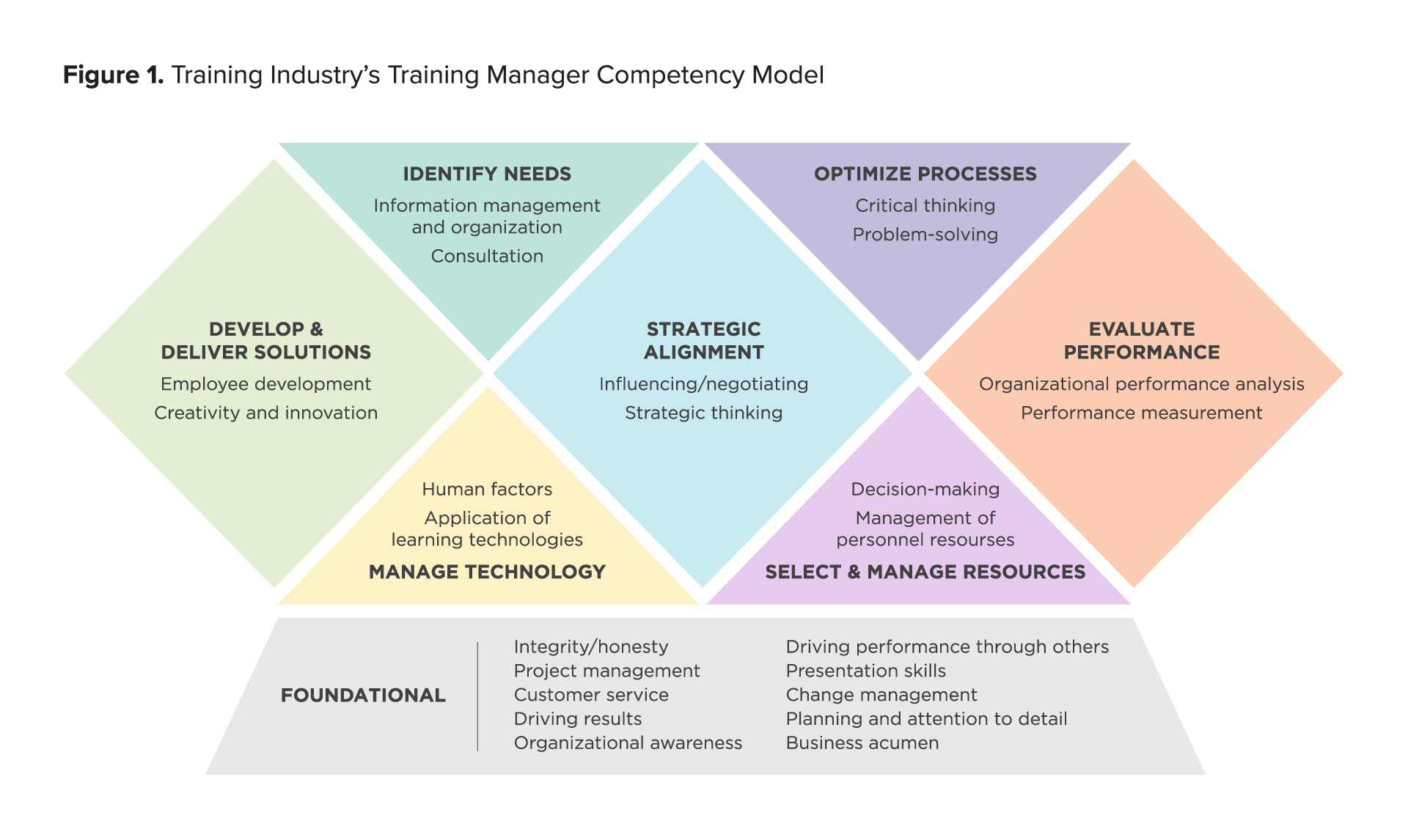
Emerging from this research, the Training Manager Competency Model™ was developed and validated through rigorous job analytic research. The model defines 24 competencies, grouped into seven core responsibilities and one foundational area. These competencies form the foundation of Training Industry’s professional development programs for current and aspiring learning leaders.
The model (Figure 1) places the most important training management responsibility, strategic alignment, aptly front and center, surrounded by the additional six responsibilities: developing and delivering solutions, evaluating performance, identifying needs, optimizing processes, managing technology, and selecting and managing resources. Along the bottom lie the foundational competencies associated with more generalized management responsibilities.
The 7 Core Responsibilities
Today, this model serves as the foundation of Training Industry’s courses for learning professionals, enabling Training Industry to provide targeted professional development resources for current and aspiring learning leaders. The seven core responsibilities outlined in this model are defined below.
- Strategic Alignment: Connect the training function with the organization’s goals and objectives and secure stakeholder support for imperative training initiatives.
- Identify Needs: Diagnose business need, performing analyses to understand the organization’s problems and determine if training is the right solution.
- Evaluate Performance: Measure the effectiveness of training in meeting business needs and improving organizational performance.
- Develop and Deliver Learning Solutions: Design and deliver learning experiences that address business needs using the results of needs assessment and evaluative information.
- Optimize Processes: Improve systems and workflows associated with running a training organization.
- Select and Manage Resources: Oversee the people, materials and vendors involved in training operations.
- Manage Technology: Leverage learning technology and manage technical personnel required for creating, managing and delivering training.
Where Training Managers Feel Most (And Least) Confident
The Training Manager Competency Model research is ongoing; current data collection efforts center on training managers’ own perceptions of their proficiency across the seven core responsibilities and each of the 24 competencies.
Self-assessments from nearly 3,000 training professionals highlight the most critical competency gaps within the profession at large and can help inform and target training managers’ own development (see Figure 2).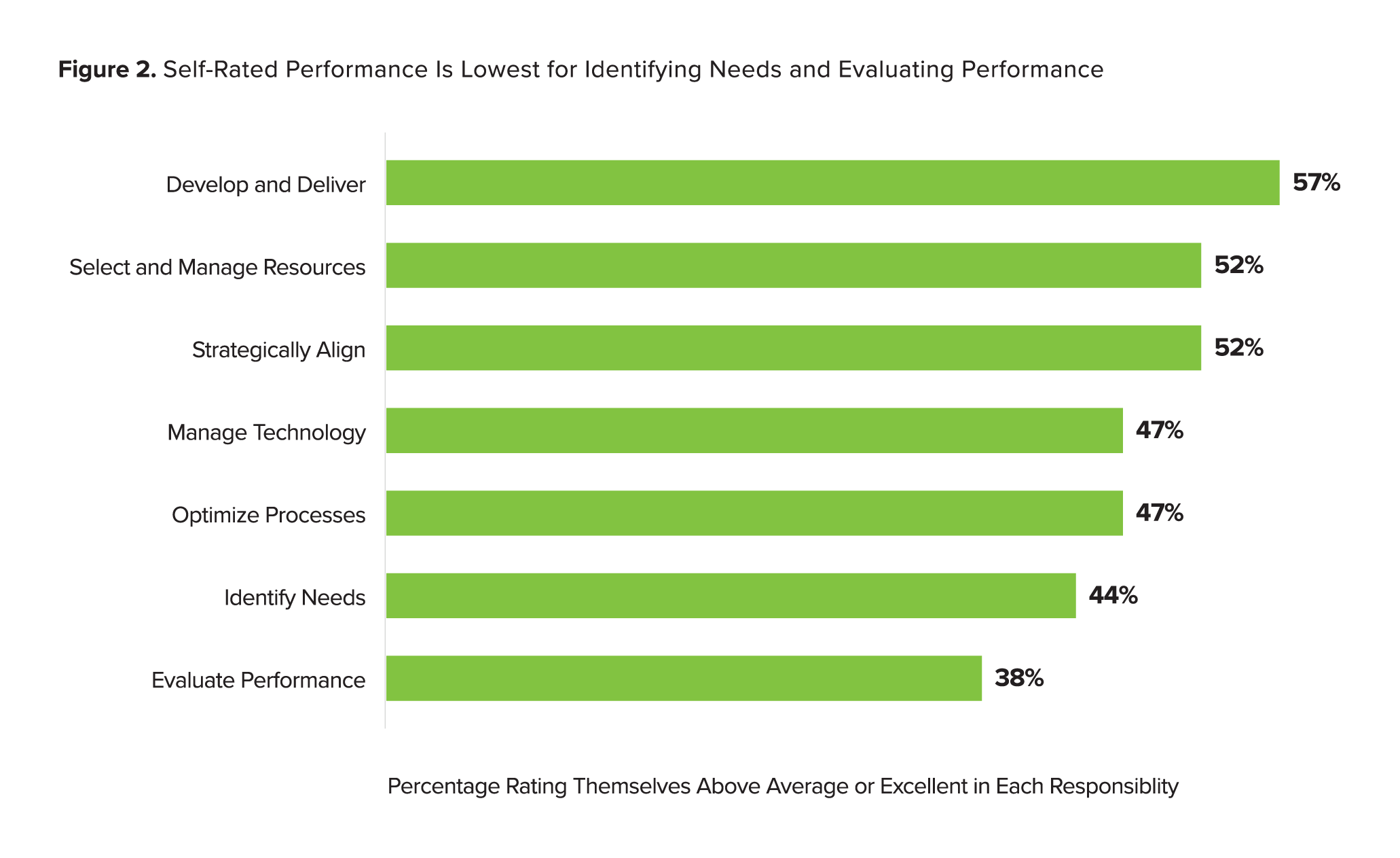
Learning professionals tend to feel the most confident in their ability to develop and deliver solutions and the least confident in their ability to identify needs and evaluate performance. This is an important reminder that the most successful learning professionals go beyond simply developing great training; they validate the need for training and measure its impact.
With this in mind, an interesting counterpoint comes from our ongoing L&D Career and Salary research, wherein learning leaders share where they need the most development. Figure 3 shows that although learning leaders tend to rate their ability to strategically align programs relatively high, they also recognize the need for further development in this area.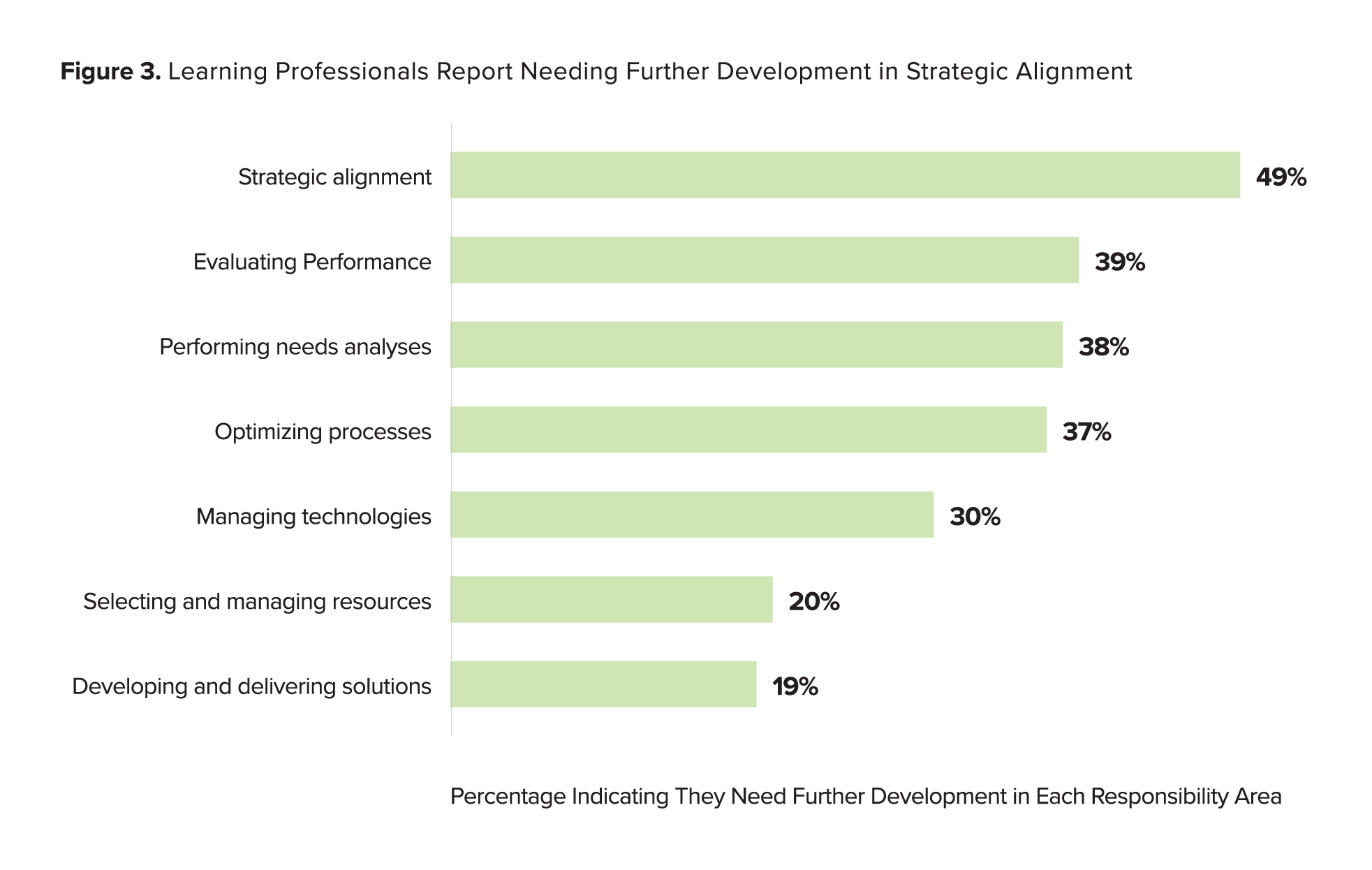
Case-in-Point: Applying the Model in Practice
To illustrate how these competencies translate into practice, here are a few examples of how real training managers have applied the model in work. For example, a Certified Professional in Training Management (CPTM) recently shared that he used the model to help shape his performance review and development plan. This enabled him to have meaningful conversations with his supervisor about where he was excelling and where he had opportunities for continued growth.
Another example comes from a training manager at a global manufacturer. She recognized that her team had been delivering a steady stream of compliance courses that were viewed as a check-the-box activity, rather than programming that would deliver real business results. Leaning into developing her strategic alignment competencies, she met with operations leaders to demonstrate how training initiatives directly contributed to reduced safety incidents on the production floor. By aligning around the outcomes and encouraging leaders to reinforce learning from the top down, she was able to improve the efficacy of her programs and demonstrate their value.
Similarly, another CPTM at a health care company focused on developing his competencies in evaluating performance and applied his learnings by building a dashboard that tracked post-training behavior change. This allowed him to demonstrate training’s contribution and provided real-time information to guide decisions about program design and delivery. These practical applications show that by grounding their work in this model, training professionals can improve their ability to demonstrate the training function’s credibility and impact.
Using AI in the Training Manager Role
In 2025, we began asking professionals about their use of artificial intelligence (AI) in relation to their execution of the seven core responsibilities. Results indicate that professionals are using AI to some extent across all seven responsibilities and that they are most likely to be using it for the development and delivery of solutions (almost 30%; see Figure 4).
Interestingly, professionals used AI least for assessing performance (57%). Given assessing performance’s critical and also challenging role, training managers should explore ways to leverage AI to improve in this area, such as by helping to develop survey or interview questions, combing through text data for themes and insights, analyzing large data sets. 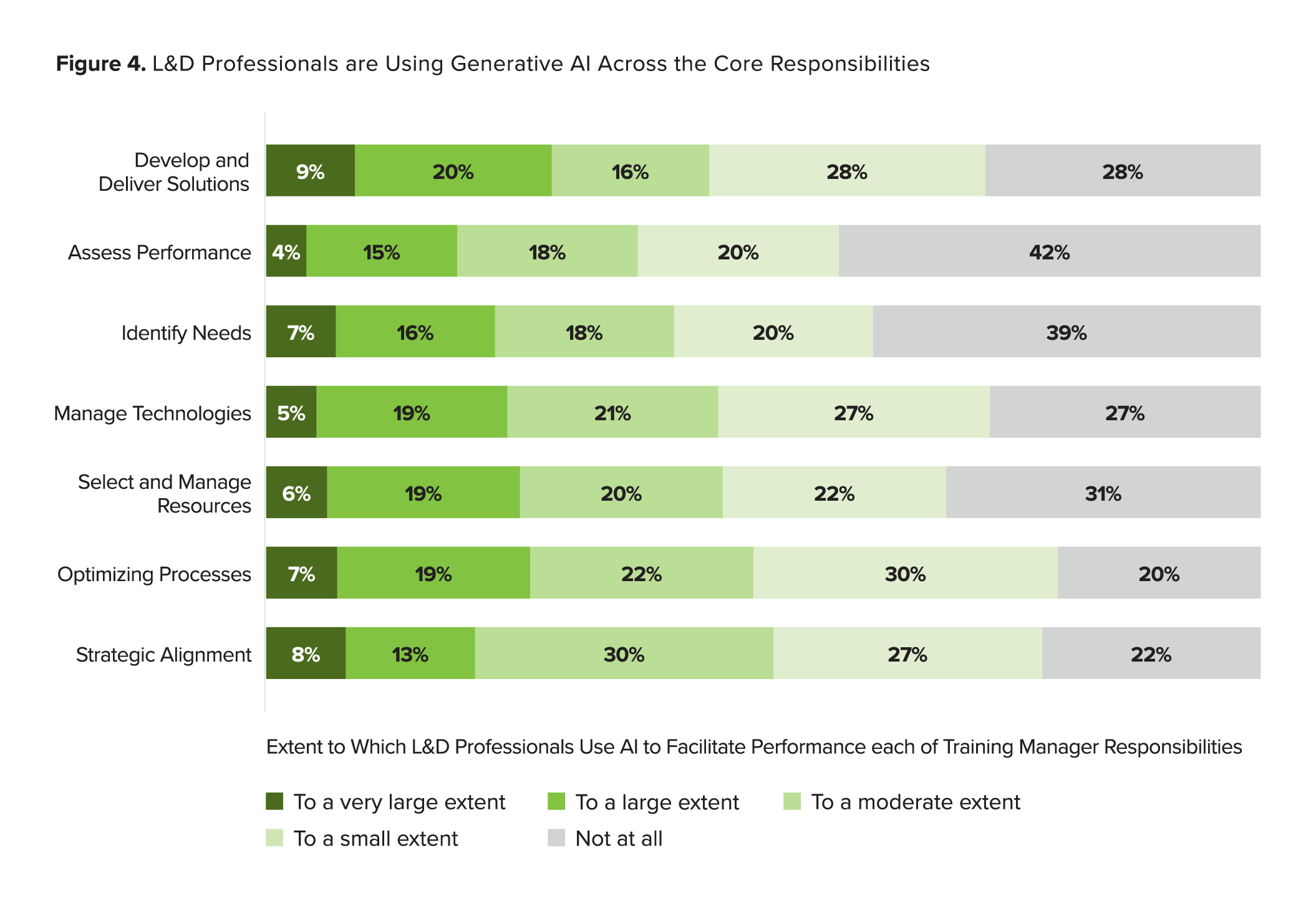
Building Competencies Where Gaps Exist
Self-assessments consistently reveal that training managers feel less confident in the areas of identifying needs and evaluating performance. These gaps are understandable — quantifying needs and impact require more technical competencies around measurement and analysis as well as the finesse that consultation competencies bring. To grow in these areas, training managers can begin with small, achievable steps. This could involve asking stakeholders probing questions about performance challenges before agreeing to build a course or developing a training intake process that ensures the right pieces of information are collected upfront. It could also mean incorporating simple evaluation elements (e.g., pilot program or control group) or partnering with human resources (HR) or analytics teams to quantify behavior change. Over time, these practices build confidence and competence, becoming habits that ensure learning leaders not only address needs but also tell compelling impact stories.
The Core Responsibilities and Salary
Our L&D Career and Salary research also shows that higher salaries are linked to excellence in the core responsibilities of strategic alignment, optimizing processes, and selecting and managing resources. This points to areas where learning leaders can focus their development efforts if increased compensation is a goal.
Our research has also found that the use of AI to support core responsibly execution may increase salary, with learning professionals who used AI to at least a moderate extent for at least one of the core responsibilities reporting median salaries more than 10% higher than professionals who did not ($117,000 vs. $105,000).
Keeping the Model Relevant
As work and L&D processes evolve, it’s important to continue to test and validate the Training Manager Competency Model™. For this reason, we gather data to validate the model on an ongoing basis. To date, nearly 3,000 training professionals have provided ratings of the competencies within the model. Our research has shown that the competencies and core responsibilities have stood the test of time in terms of their importance and frequency of use.
Next Steps for Training Managers
To strengthen your effectiveness and prepare for future challenges, consider these actions:
- Assess Yourself: Take the Training Manager Competency Model Self-Assessment to identify strengths and growth areas.
- Pick One Focus Area: Choose one core responsibility to emphasize in the next quarter, such as needs analysis or process optimization. Use this professional development template to plan your development activities.
- Collaborate Broadly: Partner with colleagues in finance, operations or analytics to strengthen alignment and performance evaluation.
- Invest in Growth: Explore professional development opportunities, such as CPTM or other courses, that align with the model.
By taking intentional steps, training managers can transform their role from transactional to strategic.