
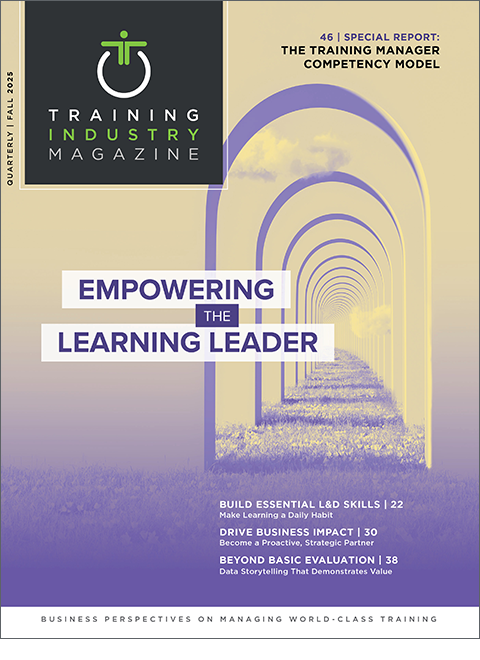
Published in Fall 2025
The role of the chief learning officer (CLO) is about more than overseeing training programs. Learning executives are expected to drive business strategy, influence senior leaders and guide organizations through near constant change. For many, the path to CLO starts as a training manager. Combining both learning and leadership, training managers have a unique opportunity to build the skills and experiences that will prepare them for the executive level.
Leadership Pipeline Through Training Managers
Training managers sit in a critical position. They translate organizational strategy into learning solutions while also managing people, processes and resources. This exposes them to both operational and strategic demands, making the role a natural stepping stone toward executive leadership. In fact, Training Industry’s ongoing L&D career and salary research identified training managers as a common precursor to director and executive-level learning and development (L&D) job roles.
Bridging the Gap Between Manager and Executive
But while at least half of learning leaders aspire to the CLO level, less than 1% actually achieve that senior L&D role. To prepare yourself and gain a competitive advantage, training managers must seek out opportunities that stretch them beyond day-to-day program management:
- Gain Enterprise-Wide Exposure: A key here is understanding the connection between training efforts and both organizational strategy and outcomes. You can gain that understanding by volunteering to represent L&D on enterprise projects, asking for opportunities to brief senior leaders on learning impact and shadowing colleagues in other departments to gain insight into their challenges.
- Build Influence Outside of L&D: Future CLOs need the trust of business leaders. As a training manager, you can start earning that trust now by partnering with stakeholders in other functions, learning their processes and jargon and demonstrating your ability to understand and help alleviate their business problems. Focus on actively nurturing your relationships with leaders in finance, operations and human resources (HR) to expand your reach.
- Develop Financial Fluency: Budgets, return on investment (ROI) and resource allocation may feel outside your wheelhouse, but financial fluency is necessary at the executive level. To build financial fluency now, take ownership of your budget, learn to make a business case and track your impact. Find metrics that will quantify the value of learning in terms that senior leaders appreciate, such as performance outcomes, productivity or cost savings.
- Champion Change: Senior L&D leaders must be able to guide their organization through transformation. As a training manager, you should seek opportunities to lead change efforts. This could mean stepping up when new technology is implemented, playing a role in shifting learning culture or managing large-scale rollouts. These experiences give you practice aligning stakeholders, communicating a vision for change and helping others adapt to new approaches to work.
Training Industry’s Resources
As you think about your own career path, it’s also worth considering how your current skills align with those required by the CLO role. In this issue, my colleague and I share a special report on the Training Manager Competency Model, which outlines the key capabilities training managers need to succeed. We are also in the process of developing a competency model to define what’s required in senior L&D level. Preliminary results of this effort show that the leap from manager to executive is less about learning new technical skills and more about expanding your scope and approach. We’re also getting ready to launch a brand new program focused on preparing future senior L&D leaders.
For training managers with aspirations of becoming CLOs, that’s encouraging news. You don’t have to wait until you’re promoted to begin building executive readiness. Start where you are, with the responsibilities you already hold, and look for opportunities to practice the skills that matter at the top. Your opportunity is clear: today’s training managers are tomorrow’s senior leaders.