
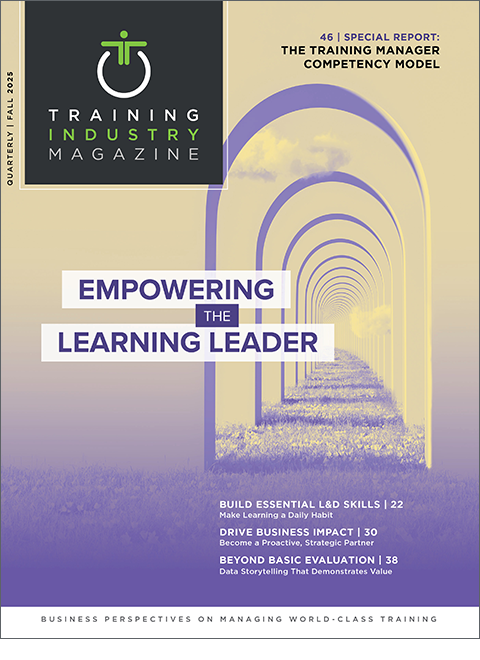
Published in Fall 2025
Artificial intelligence (AI) has officially arrived in the world of learning and development (L&D), and no, I’m not talking about replacing humans with robots or turning every training into a chatbot. I’m talking about real, strategic potential. The kind that helps us move faster, think smarter and design more human-centered learning experiences at scale.
We’re at a turning point. Learning and development teams must transform their operations, partnership dynamics and performance measurement systems to achieve the maximum value from AI investments.
The Old Way: Efficiency < The New Way: Intelligence
The first implementation of AI tools focused on boosting operational efficiency by performing tasks such as automatic course tagging, video transcription and document summarization. Helpful? Sure. But limiting.
The discussion now centers around making better decisions. For example, AI analysis of learning behavior patterns can enable organizations to forecast upcoming skill requirements and detect learner disengagement and underutilization before managers become aware. That’s a strategy-changer.
L&D’s New Role: Strategic Connector
The majority of L&D teams face excessive workloads. Our responsibility includes creating top-quality training programs and developing leaders while fostering organizational culture transformation and achieving exacting measurement goals. AI can serve as an essential partner for strategic decisions, helping L&D teams advance their role from content management and training administration toward becoming strategic connectors.
Through data interpretation, we generate actionable insights that connect learning programs to organizational talent strategies and enable leaders to track genuine growth patterns. The implementation of AI systems strengthens our decision-making abilities rather than replacing them.
With AI, we become data translators, pattern recognizers and change agents. Our value lies not in what we deliver but in how we align development strategy with organizational intelligence.
This means using AI to answer higher-order questions like:
- What skills will our workforce need 12 months from now?
- Where are the hidden high-potential employees who aren’t being developed?
- Which learning experiences are creating the most meaningful behavioral shifts?
AI in Learning: What’s Working
AI technologies transform both learner experiences and educational results in real-world applications, including:
Adaptive Learning Paths
AI-based platforms now use adaptive learning paths to modify content instantly according to learner actions, their abilities and target objectives. The result is a combination of personalized learning paths that enables students to avoid unnecessary content while advancing through their educational journey.
Predictive Analytics
The predictive capabilities of AI enable organizations to identify which teams or roles face skill gap risks so they can implement preventive measures instead of waiting for performance declines.
Conversational Tools
AI-powered coaches and chatbots provide immediate support through guided reflections and reminders, which help learners reinforce their knowledge, especially during leadership development and onboarding processes.
Smarter Content Discovery
Natural language processing technology provides better content classification and recommendation accuracy than traditional tagging systems, which results in improved learning library usability and discoverability.
AI Roadblocks in L&D
Let’s not pretend it’s easy. AI in L&D brings real challenges, such as:
Bias and Data Ethics
AI achieves its level of performance based on the quality of data it receives for learning. Our failure to monitor data collection processes will lead to the reinforcement of current biases and incorrect learner assumptions.
Change Fatigue
Some employees and L&D professionals maintain skepticism or experience burnout regarding new technological developments. The implementation of AI tools without proper context or employee involvement can create more problems than solutions.
Capability Gaps
The majority of teams lack experience in developing basic competencies related to data fluency and AI literacy and learning analytics. We must upskill in these areas before progress can be made. This includes ethics alongside transparency and inclusivity, which serve as essential foundation elements for the effective use of AI as a tool.
Human + Machine > Either One Alone
The goal isn’t to replace human instructional designers or facilitators; it’s to elevate their capacity. AI can surface insights, but only humans can apply context. Machines can personalize content, but only people can build trust and community. Together, they unlock new dimensions of learning impact.
AI technology provides both speed and customized learning capabilities and extended reach. The core elements of L&D, which include connection and context along with cultural elements, remain essential despite the capabilities of AI systems.
We still need people to fulfill three essential responsibilities:
- Develop psychological safety, along with trust within a learning environment.
- Understand the lived experience behind the data.
- Ask essential questions that drive transformation, such as “so what?” and “now what?”
AI applications in learning development function best when they enhance human activities instead of eliminating human participation.
What’s Next: Moving from Hype to Habit
Forward-thinking L&D leaders implement AI tools rather than simply testing them. These leaders embed AI into the flow of work and use it to support performance.
Here is what I believe the future looks like for those leaders:
Learning is Embedded, Not Scheduled
AI can deliver nudges, microlearning and support in the moments that matter.
Skills Data Fuels Talent Strategy
Learning analytics will become a key input in decisions around hiring, succession and workforce planning. This type of data will also prove the return on investment of L&D teams, making us a revenue-generating portion of an organization, not just a budget line item.
Programs Become Ecosystems
AI will help us stitch together formal, social and experiential learning into an ecosystem that evolves with the learner, at the time of need.
This type of innovation doesn’t happen by itself. We have to lead it.
5 Questions to Help You Get Started
Wondering how to explore AI in your L&D strategy? Start with these questions:
- What business problem are we trying to solve? Avoid “cool tool” syndrome. AI should support a clear learning or performance need.
- How are we protecting learner data and privacy? You should be asking difficult questions about the data management practices of your vendors and platforms. Work with your IT and data security teams to vet new vendors and embed the proper channels for security and protection of sensitive data.
- Where do we need to build capability on our teams? Don’t wait for IT. L&D professionals need a dedicated space to learn about the language of AI terminology and data concepts.
- Who’s missing from the conversation? The development of responsible and inclusive AI experiences requires diverse voices to participate in the process.
- How will we measure success beyond completion rates? You should be able to tie success metrics to behavior change, performance effects, and business results.
Leading the Learning Evolution
The fundamental nature of learning will remain intact while AI demands that leaders develop clearer, more creative and courageous approaches. L&D professionals maintain a strategic position between innovation and impact.
Our mission consists of two parts: we’re not here to chase trends or wait for permission; we have to shape how our people grow, adapt and even thrive in this rapidly changing landscape. The value of AI lies in our hands because we determine how we choose to wield it in unlocking human potential, fostering equity and designing learning experiences that matter.
So, let’s be bold. Let’s be the ones who prove that when human understanding meets with intelligent systems, learning doesn’t just evolve — it transforms.