
In the learning and development (L&D) space, self-awareness is frequently evaluated in assessment and development initiatives, is part of leadership development programs and is a topic or goal for coaching.
However, to develop self-awareness in leaders, it is important to remember that the following must be in place:
- One must know and understand what self-awareness is, because if they don’t know what it is, how can they develop it? Self-awareness is a complex, multi-layered and ever-evolving trait.
- Individuals must be motivated to develop it. They must understand why they are developing it and how it will benefit them and their leadership.
- A one-off training or coaching session is just one piece of the puzzle in developing leaders’ self-awareness. True growth requires ongoing effort and multiple “pieces,” as self-awareness naturally ebbs and flows — it’s an infinite game.
- Reflection and reflective activities, integrated with or following other training interventions, are essential for truly developing self-awareness.
How to Begin Developing More Self-Aware Leaders
To begin developing self-aware leaders, L&D professionals must first understand what self-awareness is.
The figure below is a visual representation and simple overview of the elements of self-awareness. This can be used as a way of identifying which elements leaders may wish or need to focus on to develop self-awareness, or as a check-in as to what individual training interventions should focus on:
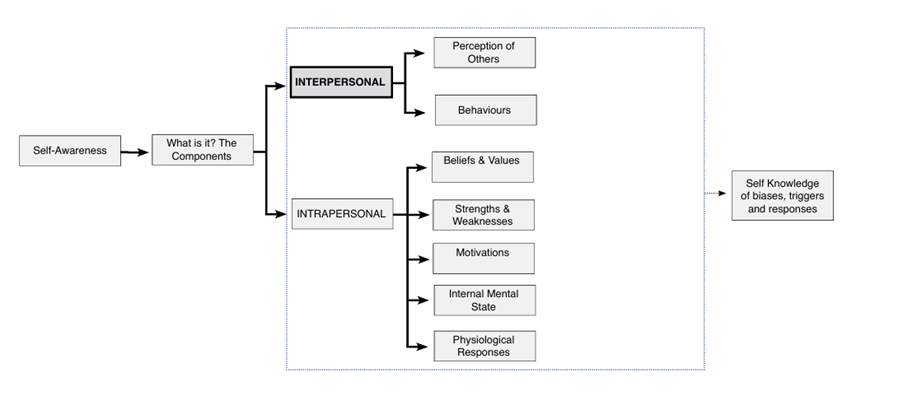
Before introducing any other interventions, it’s important that leaders are motivated to develop self-awareness. A simple way to begin is by cultivating curiosity and asking themselves, “Why do I behave the way I do?”
Initial Steps
Here are a few initial steps to help leaders develop self-awareness:
1. Do a simple 360-degree assessment, which is carried out by the leader whereby they ask two questions of their team, peers and stakeholders (making sure they record the responses) as follows:
- What do I do that you appreciate and value?
- What do I do that irritates you or gets in the way of us having a good working relationship.
2. Use a psychometric profile. Psychometrics can provide a useful starting point for the development of self-awareness and follow-up coaching. Lumina Spark is one example that looks at an individual across three personas: every day (how they show up at work); underlying (the person at their most relaxed); and over-extended (when they are stressed or overwhelmed).
3. Do a values reflection. Values influence decision making, our choices and behaviors. A values reflection can be done by asking leaders:
- What’s important to them?
- What has influenced key decisions in their life?
- To think about a time when they have been in a challenging or difficult situation, and ask themselves, what was at stake for you in that scenario?
- Or, you can give leaders a list of values and ask them to identify their top 5-10 values.
4. Reflect on everyday interactions. Each interaction with colleagues or team members offers leaders an opportunity to learn something about themselves. Have leaders reflect on the following questions:
- Why did I behave in the way I did?
- What might that tell me about me?
- What might that mean for me as a leader?
5. Reflect with a coach. After completing the above exercises, leaders should review their insights with a coach to identify key areas for growth using the visual diagram. Together, they can tailor activities to support the development of self-awareness.
Further Steps
Working With Groups
Working in groups can be both terrifying and transformational but, combined with reflection, can provide leaders the opportunity to capture glimpses of their unconscious. The success of group coaching and/or action learning depends on the levels of openness, trust and willingness to embrace vulnerability, so they should be run by a skilled facilitator or coach. Leaders can then be encouraged to reflect on the following questions:
- How did I show up in this group?
- What did I find challenging? Why might that be?
- Who was I drawn to? What was it about that person that drew me toward them?
- Who irritated me, and why? The things that bother us in others often mirror aspects of ourselves that we struggle to accept or recognize.
Reflection
Reflection and reflective activities are essential in developing self-awareness. Therefore, leaders should be introduced to ways to reflect, how to capture and process their reflections in a way that supports individual learning preferences.
Possible methods include (but are not limited to):
- Journaling: using free-fall writing or with structured prompts, such as: “What might that be telling me about myself?” Or, “What does that mean for my leadership?”
- Mind mapping or drawing.
- Thinking pairs with a thinking partner using the principle of Nancy Kline’s Time to ThinkÔ.
Self-Awareness Is Ever Evolving
Finally, it’s important to recognize that self-awareness is a dynamic trait; it ebbs and flows over time and is never fully complete. The minute a leader perceives they are self-aware, they are potentially slipping into self-delusion or hubris. As Laurence Barrett says in “A Jungian Approach to Coaching,” “It is an elusive image that slips away from us as soon as we feel we can grasp it.”
For leaders, every interaction presents the opportunity for further reflection and development. The moment leaders catch themselves saying, “I am self-aware” is when they might be tipping into self-delusion. Building self-awareness is an ongoing, lifelong process, which can feel daunting. However, the more effort leaders put into the reflection required, the more they move toward self-acceptance and deeper self-connection. The result is a stronger, more grounded leader.